
Assam Government has staged the Assam Uniform Civil Code Bill, 2026 in the Assam Legislative Assembly. This bill was passed by the Assembly on 27 May, 2026. Assam thus became the third state after Uttarakhand and Gujarat to adopt UCC framework. The Assam Legislative Assembly’s adoption of the Uniform Civil Code (UCC) Bill, 2026 is a turning point in India’s continuing discussion on social change, secularism, and individual laws. In an effort to establish a standard framework for civil procedures including marriage, divorce, inheritance, and adoption. The action has sparked debate and support throughout the nation, not just in Assam.
Table of Contents
What is Assam Uniform Civil Code Bill, 2026
The Assam Uniform Civil Code Bill, 2026 is a set of civic laws introduced by the Assam Government to establish a sense of commonness among the individuals. This bill claims to bring all citizens under one umbrella and form common rules in terms of marriage, inheritance, succession, adoption, live-in relationships and divorce. While the opposition strongly condemned the Bill, the Government of Assam strongly upholds the belief that the Bill will meet with the broader objective of establishing unity among its citizens.
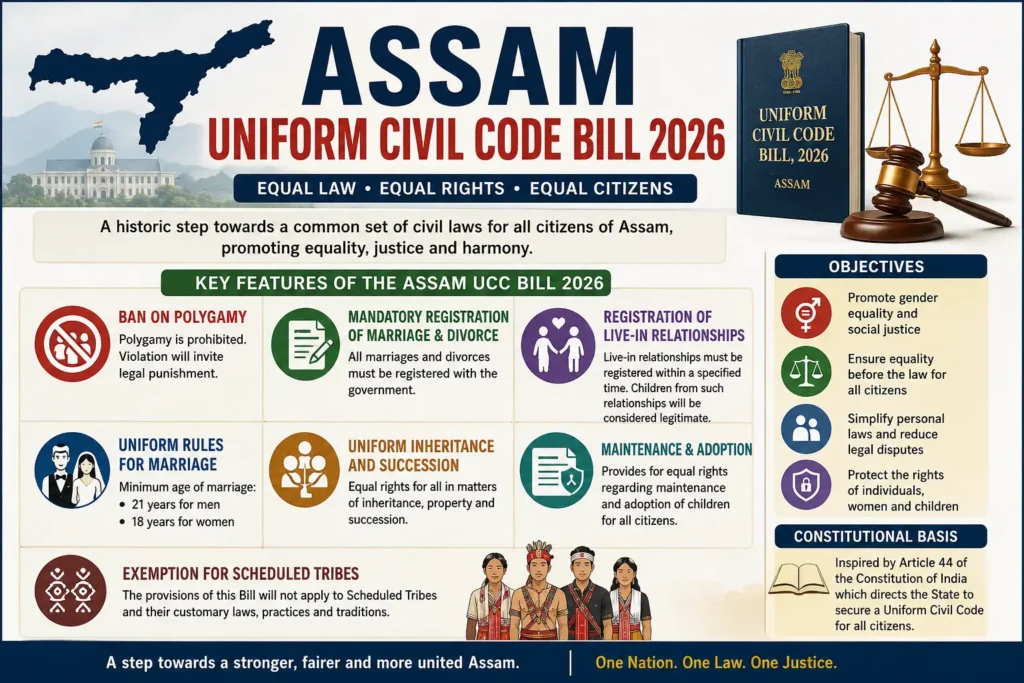
Key Features of the Bill
- Ban on Polygamy: The Bill’s ban on polygamy is one of its most talked-about features. This has been portrayed by the Assam government as a significant step toward legal uniformity and gender justice. Many proponents believe that prohibiting polygamy is essential to guaranteeing women’s equality and dignity in marriage. Opponents contend that rather than state-driven legal action, broader social consultation should lead to changes in personal laws.
- Mandatory Marriage Registration: The mandatory registration of marriages is another important aspect of the Bill. Compulsory registration, according to the Assam government, will minimize child marriage, fraudulent marriages, and marital status-related legal problems. Practically speaking, registration will additionally enhances women’s entitlement to legal protections related to custody, succession, and alimony.
- Focus on Live-in Relationships: Perhaps the most controversial aspect of the Bill is the requirement for registration of live-in relationships. Critics have described this provision as an intrusion into individual privacy and personal freedom. Many civil rights activists argue that while the state may regulate legal relationships, monitoring consensual adult relationships risks expanding governmental control into private life. At the same time, the Bill recognises children born from live-in relationships as legitimate, which supporters view as an important legal safeguard.
- It’s interesting to note that many conventional tribal customs and Scheduled Tribes are exempted from the Bill’s restrictions. Multiple native cultures with unique social customs and laws can be found in Assam. The exemption seems to be an effort to strike a compromise between constitutional protections, tribal identity preservation, and legal conformity. However, there has also been discussion over this exemption. Opposition parties wonder if a legislation can be genuinely said to as “uniform” if certain segments of society are left out of its purview.
A broader political and constitutional framework is also necessary to comprehend the Assam Uniform Civil Code Bill, 2026. Article 44 of the Indian Constitution, which urges the state to strive toward a common civil code for all citizens, has long been associated with the concept of a uniform civil code. However, the subject has been politically controversial for decades due to India’s vast religious and cultural diversity. Assam’s ruling is indicative of a larger trend in modern Indian politics, where issues of governance, law, and identity are becoming more intertwined.
Criticism of Assam Uniform Civil Code Bill, 2026
The Assam UCC Bill, 2026 is criticized for raising a number of constitutional, social, cultural, and political issues despite being portrayed as a reform move that promotes equality. Legal experts, civil society organizations, minority groups, women’s rights advocates, and opposition parties are the sources of the criticism.
- “Uniform” but Not Actually Uniform: The Bill’s exemption of Scheduled Tribes and their customs is one of the biggest objections. Critics contend that the law cannot truly be referred to as a “Uniform” Civil Code if significant segments of society are left out. The concept of legal uniformity itself is contradicted by this selective application. Opponents raise constitutional concerns about whether the state is advancing equality or merely implementing reforms differently in different neighborhoods.
- Danger to Religious and Cultural Diversity: India has long maintained a system of legal pluralism in which many religious groups uphold their own customs on marriage, inheritance, and family issues. Critics contend that the Assam UCC may progressively undermine cultural autonomy and degrade this pluralistic culture. Many people in Assam’s ethnically and religiously diverse community worry that enforcing a common framework will upset delicate social balances and make minority communities feel more alienated.
- Excessive State Interference in Private Life: The requirement that live-in partners be registered has drawn a lot of criticism. This is viewed by many academics and activists as needless monitoring of adult interpersonal connections. Mandatory registration may infringe the right to privacy guaranteed by Article 21 of the Constitution, according to critics who contend that consenting relationships between adults should remain private. These restrictions may particularly impact women, young couples, and socially vulnerable groups. This clause has been referred to by some legal observers as “moral policing through law.”
A broader national discussion over secularism, democracy, cultural rights, and state power in India is reflected in the criticism of the Assam UCC Bill. Critics view the Bill as selective, invasive, and politically tinged, while advocates characterize it as progressive and reformist. The debate over the Bill shows that the subject of a Uniform Civil Code is more than just a legal one; it is closely related to identity, citizenship, diversity, and the future of Indian secularism.
When was the Assam Uniform Civil Code Bill, 2026 adopted?
The bill was adopted on 27 May, 2026.
Does the Bill apply to all communities in Assam?
No. The Bill exempts Scheduled Tribes and protects many tribal customary practices and traditions.
What are the legal marriage ages under the Bill?
The Bill sets:
21 years for men and 18 years for women as ideal marriageable age.
Why are Scheduled Tribes exempted?
The exemption aims to protect indigenous customary laws, traditions, and constitutional safeguards related to tribal identity and autonomy.
You may also read: https://wisdomjuncture.com/maa-kamakhya/
Follow us for more content on :
Pingback: Nijut Moina Scheme 2025: Version 2.0 launched - WisdomJuncture
Pingback: 8th Pay Commission: Big Salary Hike Ahead Soon! Latest Updates, Fitment Factor, Salary Calculator, Implementation Timeline - WisdomJuncture