
Rath Yatra is the annual chariot festival celebrated in one of India’s most widely known temples of Lord Jagannath. The temple is located in Puri, Odisha and it is the home to holy Lord Jagannath. Every year thousands of devotees throng the temple premise to seek the blessings of the Lord and to gain a spiritual experience. Rath Yatra is one of the grand celebrations of the temple observed annually. This festival is dedicated to Lord Jagannath, who is believed to be an incarnation of Lord Vishnu. This article gives you a total picture of the festival, celebrations, dates timing and all other travel details to plan your trip to the festival.
Table of Contents
What is Rath Yatra?
Believed to be as old as the Jagannath Temple, Puri – the Ratha Yatra or the Chariot Festival as its popularly called outside India is a unique festival in more ways than one. This is the only festival in India, where the deities are taken out of the temple premises. People of all religion, caste and creed join in and revel in the sea of humanity that Puri transforms into. Apart from being observed in numerous Indian cities, the festival is observed with great fanfare right from New Zealand to South Africa, New York to London.
Devdutt Patnaik who writes on relevance of mythology in modern times aptly sums up the reason behind the popularity of Lord Jagannath Cult and the Chariot Festival -“Locally Jagannath is called Kaliya, for its black colour, with great affection, although modern colour prejudice makes many insist that Krishna is actually blue. He is God, of course, spelt with a capital G, but more than that he is your friend, as the dominant mood in the temple is of sakha-bhaav, devotion through the emotion of friendship.”
Though many think it’s a nine day festival – the onward journey of the Holy Trinity to Goddess Gundicha Devi’s Temple and culminates with the Return Journey after eight days. In reality the festival stretches from the day of AkhayaTrutiya (in April) and culminates with the Return Journey of the Holy Trinity to the Shree Mandir premises.
The Yatra of Rath Yatra- Series of Events
- The yatra or the journey begins at Shri Jagannatha Temple, Puri.
- The next step is Pahandi, where the deities are brought outside of their sanctum through a holy procession.
- Then comes Cherra Pahanra. Here the Gajapati King himself sweeps the chariots with a golden broom.
- The fourth stage is the Rath Yatra, where the actual journey begins by pulling the chariot with the deities placed on it.
- The journey moves through the roads of Bada Danda and devotees welcome the holy chariot with grand fervour.
- The chariot then reaches the Gundicha Temple, which is believed to be the Aunt’s house of Lord Jagannath.
- The deities halt at their aunt’s place for nine long days and chariot waits at this point.
- The Bahuda Yatra begins post nine days stay at Gundicha Temple.
- The deities in gold ornaments start on with their return journey to the temple. This is called Suna Besha
- The return journey begins and devotees gather to worship the Lord in the temple.
The Holy Chariots of Rath Yatra
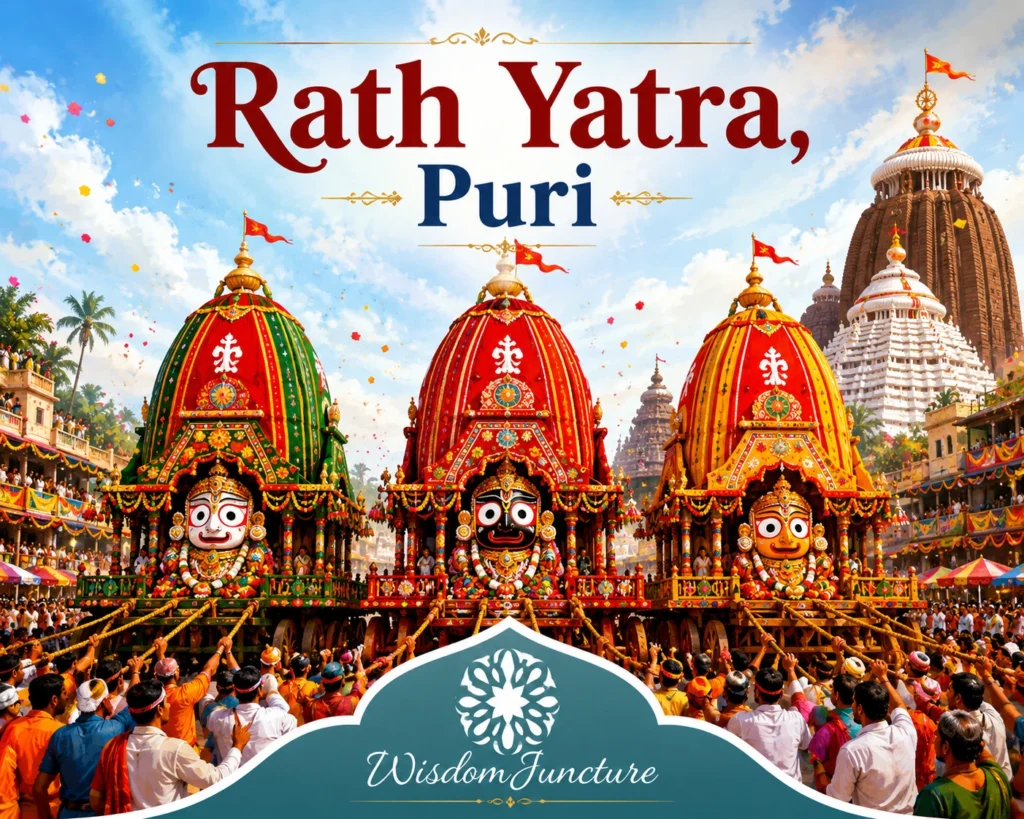
Every year new chariots are built with fresh timber and the previous year’s chariots are discarded. It is surprising to note that a group of carpenters called the Maharanas have been building the three chariots since time immemorial with accurate measurements and dimensions. The following are the details of the chariots:
- The first chariot in the rath yatra is the Nandighosha, which belongs to Lord Jagannath. It is approximately 45 ft in height and has 16 wheels. It is painted in red and yellow colour and has a Garuda emblem on it. It is also the largest of all three chariots.
- The second chariot is Taladhwaja and it belongs to Lord Balabhadra. It has 14 wheels and it is approximately 45.6 ft in height. The colour of this chariot is red and green and it has palm tree emblem on its flag.
- The third chariot belongs to Goddess Subhadra and it is known as Devadalana or Darpadalana. It has 12 wheels and it is approximately 44.6 ft in height. It is painted in red and black colour and it is considered as the smallest of the three chariots.
Travel Guide- Rath Yatra
Travelling to Puri for Rath Yatra should be a pre-planned trip. Considering the massive crowd during the yatra, it is advised to reach Puri 2-3 days in prior to the festival and stay until the return journey concludes. The festival is usually held in the month of July and this year the event begins on 16 July, 2026. Tourists can access the route through flight, train or by road. The nearest airport is Biju Patnaik International Airport, Bhubaneshwar which is approximately 60km from Puri. On reaching the airport travelers can hire a cab/taxi to Puri which takes 1.5 to 2 hours from the airport.
Puri Railway Station is well connected with major Indian cities like Mumbai, Delhi, Kolkata, Chennai, Guwahati, Bengaluru. However, certain special trains are also introduced to beat the rush during Rath Yatra period.
Puri is also well connected with highways via cities like Bhubaneshwar, Konark, Cuttack etc.
Upon reaching Puri, there are several stay options ranging from luxury hotels to budget options for a comfortable stay during the trip.
What is Rath Yatra?
Rath Yatra is the annual chariot festival of Lord Jagannath, Lord Balabhadra, and Goddess Subhadra, celebrated with great devotion in Puri, Odisha.
Where is the famous Rath Yatra held?
The most famous Rath Yatra is held in Puri, Odisha, attracting millions of devotees and tourists from India and around the world.
Why is Rath Yatra celebrated?
The festival commemorates the annual journey of Lord Jagannath and his siblings from the Jagannath Temple to the Gundicha Temple, symbolizing the Lord’s visit to his aunt’s home and his blessings for all devotees.
When is Rath Yatra celebrated?
Rath Yatra is celebrated every year on the Dwitiya Tithi (second day) of the Shukla Paksha in the Hindu month of Ashadha, usually falling in June or July.
Can anyone pull the chariots?
Yes. Devotees from all backgrounds are allowed to pull the chariot ropes, and it is considered an act of great spiritual merit.
What are some nearby attractions in Puri?
Popular attractions include:
Konark Sun Temple
Puri Beach
Chilika Lake
Raghurajpur Heritage Village
Sakshi Gopal Temple
You may also read: https://wisdomjuncture.com/konark-festival/
Follow us for more such content: