
A historic project called Mission Senehjori was started in Assam with the goal of reviving, bolstering, and promoting Assam’s renowned Muga silk industry worldwide. The mission, which was announced on June 2, 2026, aims to improve the standard of living of over 2.5 lakh weavers, rearers, craftsmen, and businesses throughout the state while transforming the entire Muga silk value chain with an investment of about ₹411 crore. Mission Senehjori wants to establish Assamese golden silk as a high-end luxury good in international markets by fusing ancient expertise with contemporary infrastructure, technological monitoring, trademarking, and market growth.
Muga silk, a distinctive natural fiber renowned for its golden sheen, remarkable tenacity, and profound cultural importance, has long been associated with Assam. Muga silk has been an essential component of Assamese culture for ages, appearing notably in ceremonial robes and traditional clothing like the Mekhela Chador. However, issues like dwindling cocoon production, interruptions from climate change, disjointed supply networks, and a lack of worldwide advertising have impeded the sector’s expansion.
Mission Senehjori uses an all-encompassing and incorporated strategy to try and solve these issues. The goal is to improve the Muga silk ecology at every level, from weaving, value creation, tourism, and exports to facilitating plant agriculture and silkworm hatching. Mission Senehjori is more than just an economic initiative; it is a goal to protect Assamese culture, strengthen rural communities, and make the state’s golden silk a worldwide emblem of excellence, sustainability, and craftsmanship.
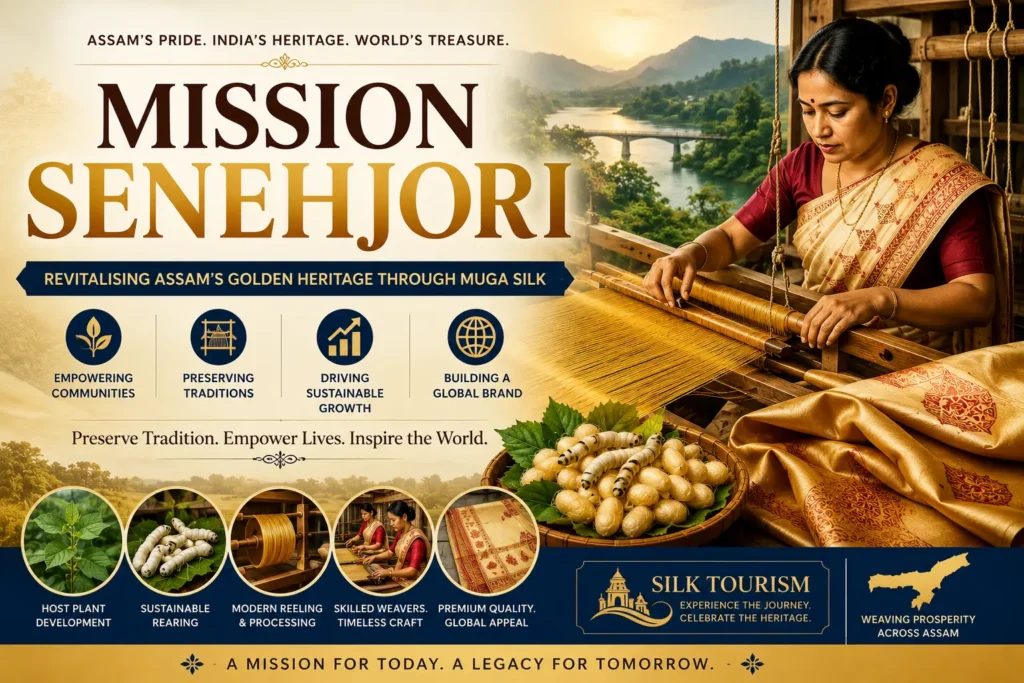
Table of Contents
What is Mission Senehjori?
Mission Senehjori is an all-encompassing, cluster-driven development initiative aimed at bolstering the Muga silk value network. In cooperation with the Assam government, the Central Silk Board, the Ministry of Textiles, and other relevant parties, the Ministry of Development of the North Eastern Region (MDoNER) initiated the mission. The mission focuses on all phases of the manufacturing of Muga silk, comprising:
a. Host plant cultivation
b. Production of silkworm seeds
c. Raising cocoons
d. Spinning and reeling
e. The extra value and weaving
f. Marketing and branding
g. Promotion of exports
h. Digital tracing
i. Silk Tourism
Key Objectives of Mission Senehjori
- Fortifying the Whole Value Chain
From the development of host plants to the final silk goods, the mission takes an all-encompassing approach. - Improving Livelihoods
Improving the socio-economic status and revenue of more than 2.5 lakh families involved in the Muga silk industry is a primary goal. - Increasing Access to International Markets
The project intends to make Assam a worldwide center for high-end Muga silk and upscale textile items. - Encouraging Sustainability
Environmentally friendly farming and production methods are promoted by Mission Senehjori. - Maintaining Cultural Traditions
For the benefit of future generations, the mission aims to preserve and advance Assam’s centuries-old silk traditions.
Major Components of Mission Senehjori
- Host Plant Regeneration: Host plants like Som and Soalu, which silkworms eat, are essential to the health of the Muga silk ecosystem. In order to guarantee a steady supply of cocoons, Mission Senehjori proposes to expand and regenerate some 5,000 hectares of host plant regions.
- Organizations of Farmer Producers (FPOs): The mission intends to create 30 FPOs, or farmer-producer organizations
- Over 1,180 FIGs, or farmer interest groups: These organizations will assist farmers in increasing output, gaining access to markets, and negotiating more favorable prices.
- Contemporary Reeling Infrastructure: Conventional reeling techniques frequently lead to variable quality and decreased output. Mission Senehjori suggests: to establish five contemporary Muga reeling units, a single Muga-spun silk mill. It is anticipated that such amenities will boost value creation and productivity.
- Digital Traceability: Users are calling for more openness and authenticity. Therefore, In order to enable consumers to follow the provenance and manufacturing process of Muga silk products, the mission intends to implement digital traceability systems for over 8,000 dwellings.
- GI Verification: In order to enable consumers to reliably identify real Assam Muga silk, the program aims to improve Geographical Indication authentication procedures. This will improve confidence in the market and aid in the fight against fake goods.
Significance of Mission Senehjori
One of the most important projects for the growth of Assam’s traditional silk industry in recent years is Mission Senehjori. The mission has enormous cultural, societal, and geopolitical significance for the state in addition to its economic ramifications. The mission is to conserve a centuries-old legacy while generating new prospects for sustainable growth and development by concentrating on the revitalization of Muga silk, something that is specifically linked to Assam.
- Maintaining the Cultural Identity of Assam: Muga silk is more than just a fabric; it represents Assamese glee, heritage, and customs. Muga silk has been used extensively in events, marriages, and significant occasions for generations, and it has been woven into Assamese society and culture. By ensuring that traditional weaving and silk-rearing techniques survive in a world that is evolving quickly, Mission Senehjori plays a critical role in preserving this priceless cultural legacy.
- Bringing Back a Fading Traditional Sector: The Muga silk industry has seen a number of difficulties in recent years, such as diminishing cocoon output, interruptions brought on by the climate, disease outbreaks, and shrinking cultivation grounds. Mission Senehjori is important because it offers an organized, long-term plan to revitalize the sector through institutional assistance, technological interventions, and infrastructure creation.
- Strengthening Rural Communities: Sericulture and weaving are major sources of income for many families in Assam, either directly or indirectly. More than 2.5 lakh stakeholders, including farmers, rearers, weavers, artisans, and businesspeople, are anticipated to gain from the project. Mission Senehjori has the ability to boost rural economies and minimize economic risks by generating jobs and raising incomes.
- Encouraging Women to Participate in the Economy: The foundation of Assamese weaving is made up of women. Each phase of the process involves women, from raising silkworms to weaving elaborate Muga outfits. Mission Senehjori is important because it can contribute to gender-balanced growth by strengthening women’s economic empowerment through enhanced market access, business prospects, and skill enhancement.
- Boosting Assam’s Global Face: Muga silk has Geographical Indication (GI) certification and is exclusive to Assam. Its potential in the worldwide market is still mainly unrealized, nevertheless. Through branding, quality certification, and export promotion, Mission Senehjori aims to position Muga silk as a high-end luxury commodity in global markets. In addition to boosting demand for Assamese silk goods, this will bolster the state’s reputation abroad.
- Promoting Sustainable Development: Through encouraging host plant cultivation, biodiversity conservation, and prudent resource management, the mission advances environmentally sustainable sericultural practices. Mission Senehjori is in line with the increasing demand for sustainable and ethically manufactured textiles worldwide since Muga silk is a natural and environmentally beneficial fiber.
- Increasing Innovation and Entrepreneurship: Mission Senehjori promotes entrepreneurship in the silk industry by assisting Farmer Producer Organizations (FPOs), cooperatives, startups, and small businesses. Modern technology, digital traceability systems, and value-added production techniques might open up new company prospects and draw in younger workers.
- Increasing the Potential for Tourism: Another key component of the mission’s importance is its focus on silk tourism. Muga Silk Trails, artisan villages, and cultural festivals are examples of initiatives that can draw tourists interested in Assam’s distinctive history. In addition to promoting Assam as a destination for cultural and experiential tourism, this can help local communities make more money.
- Supporting Atmanirbhar Bharat’s Vision: By bolstering domestic enterprises and promoting regional goods, Mission Senehjori contributes to the larger national goal of creating an independent India. The mission promotes financial independence and highlights India’s rich textile heritage to the world by boosting exports, expanding manufacturing capacity, and generating job opportunities.
Silk Tourism under Mission Senehjori
Mission Senehjori’s emphasis on creating Silk Tourism—a concept that blends cultural heritage, rural livelihoods, and sustainable tourism—is among its most inventive features. The project aims to turn Assam’s well-known Muga silk industry into a distinctive travel destination where tourists may explore the rich customs of Assamese civilization and observe the intriguing process of silk manufacture.
The term “silk tourism” describes travel activities that are focused on the history, heritage, craftsmanship, and manufacture of silk. Under Mission Senehjori, visitors will have the chance to see communities that produce silk, engage with local craftspeople, witness traditional weaving methods, and discover the full lifecycle of Muga silk—from raising silkworms to making beautiful silk clothing.
The project intends to give tourists a genuine cultural exposure while creating new revenue streams for nearby communities engaged in weaving and sericulture.
Important Elements of Silk Tourism:
- The creation of Muga Silk Trails, which would link significant Assamese silk-producing areas, is a proposal made by Mission Senehjori. Through these routes, visitors will be able to see regional markets, silkworm raising facilities, weaving clusters, and host plant farming sites. Visitors will learn firsthand about the complex process used to produce Assam’s renowned golden silk.
- A few weaving communities might be turned into tourist attractions where tourists can see traditional weaving techniques and engage with craftspeople. These encounters can aid travelers in appreciating the talent, perseverance, and artistry required to create genuine Muga silk goods.
- The goal is to create facilities that highlight Muga silk’s cultural relevance, history, and technological advancements. Students, scholars, and visitors interested in Assamese textiles may find these centers to be educational destinations.
- Additionally, Mission Senehjori promotes the planning of cultural festivals and exhibitions with a silk theme. Weaving demonstrations, fashion presentations, handicraft exhibitions, folk performances, and regional food can all be featured at these events, providing a lively forum for promoting Assamese culture.
- Beyond traditional silk production, the growth of silk tourism can generate a variety of livelihood alternatives. Local communities stand to gain from:
- a. Rural tourism endeavors and homestays
- b. Sales of Muga handicrafts and silk goods
- c. Guides for tourists
- d. Cultural exhibitions and performances
- e. Local restaurants and lodging establishments
- f. Services for travel and transportation
What is Mission Senehjori?
Mission Senehjori is a flagship initiative launched in 2026 to revitalise Assam’s Muga silk industry. With an investment of approximately ₹411 crore, the mission aims to strengthen the entire silk value chain, improve the livelihoods of over 2.5 lakh stakeholders, and establish Muga silk as a globally recognised luxury textile.
What are the main objectives of Mission Senehjori?
The main objectives of Mission Senehjori include increasing Muga silk production, expanding host plant cultivation, improving infrastructure, empowering weavers and rearers, promoting silk tourism, enhancing exports, and preserving Assam’s unique silk heritage.
How will Mission Senehjori benefit weavers and farmers?
Mission Senehjori will benefit weavers and farmers through better market access, modern production facilities, skill development programmes, Farmer Producer Organisations (FPOs), digital traceability systems, and improved opportunities for value addition and exports.
What is silk tourism under Mission Senehjori?
Silk tourism is a key component of Mission Senehjori that promotes Assam’s Muga silk heritage through tourism activities such as Muga Silk Trails, artisan villages, weaving demonstrations, silk museums, and cultural festivals. It aims to create additional income opportunities for local communities while showcasing Assam’s traditional silk industry.
Why is Mission Senehjori important for Assam?
Mission Senehjori is important because it helps preserve Assam’s cultural heritage, supports rural livelihoods, empowers women artisans, promotes sustainable development, boosts tourism, and strengthens Assam’s position as the global home of Muga silk.
You May Also Read: https://wisdomjuncture.com/nijut-moina-scheme-2025/
Pingback: Lakshmi Mistri (Lakhimi Mistri) Initiative Assam 2026: Women Empowerment Through Skill Development, Generating Rural Employment - WisdomJuncture