
Lakshmi Mistri Initiative Assam is one of the most cutting-edge initiatives for women’s empowerment and skill development was introduced by the Assam government. The program aims to improve the lives of rural women by training them building and masonry techniques so they may actively take part in state-wide infrastructure and housing projects.
Masonry and building have long been seen as male-dominated professions. Women frequently had less access to job possibilities and technical skill training, especially in rural areas. The Lakshmi Mistri Initiative seeks to close this disparity by providing women with options for sustainable employment and training them as expert masons. The Lakshmi Mistri initiative supports Assam’s overarching goals of poverty alleviation, rural development, financial inclusion, and female empowerment. In addition to improving women’s employability, it makes a substantial contribution to the state’s housing and infrastructure development initiatives.
The Lakshmi Mistri Initiative is a brilliant example regarding the way skill acquisition can serve as an effective tool for transforming the economy and society as Assam continues to embrace gender equality and inclusive growth.
Table of Contents
What is Lakshmi Mistri (Lakhimi Mistri) Initiative?
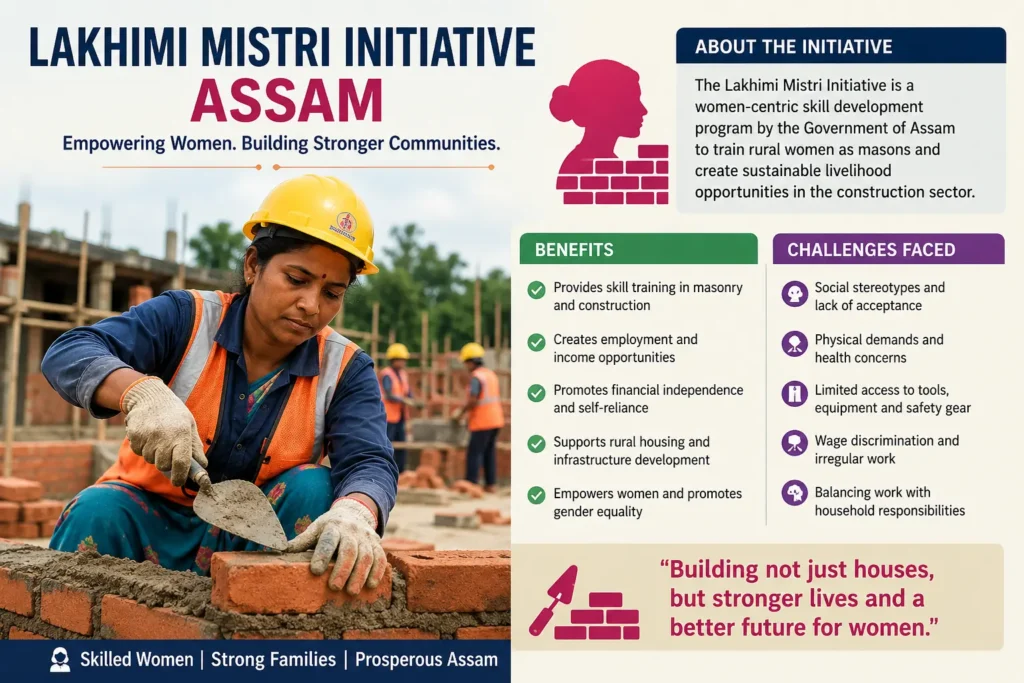
The Government of Assam launched the Lakshmi Mistri Initiative, a women-focused skill development program, to teach women masonry and construction-related skills. This program offers professional training in masonry, bricklaying, plastering, foundation work, concrete mixing, construction safety, and other critical building skills to women from rural communities and Self-Help Groups (SHGs). These women become qualified masons who can work independently or take part in government-sponsored housing projects after completing their training successfully.
In the context of rural housing initiatives, where there is an increasing need for qualified labor, the program is especially significant. The program tackles manpower shortages in the construction industry as well as job creation by developing a skilled pool of female masons.
While “Mistri” refers to a skillful worker or mason, “Lakhimi” represents wealth and well-being. The program’s goal of fostering prosperity through skill-based employment is reflected in the name.
Key Objectives of Lakshmi Mistri Initiative:
The project aims to further rural development and women’s empowerment through a number of significant objectives:
- By giving women employable technical skills, the main goal is to empower them both socially and economically.
- The initiative aims to provide women with sustainable livelihood alternatives so they can enhance their quality of life and earn a consistent income.
- The project challenges cultural preconceptions and advances gender equality by encouraging women to pursue historically male-dominated occupations.
- The program’s goal is to produce a workforce with the necessary skills to support infrastructure development and rural housing initiatives.
- Giving women professional masonry training enables them to develop specialized skills that are in high demand in the building sector.
- Local economic development and poverty reduction are strongly impacted by increased employment and income generation.
- The program encourages women to work for themselves and start their own businesses, which lessens reliance on outside support networks.
Key Features of Lakshmi Mistri Initiative
Experts and technical educators will deliver structured masonry training for women chosen under the Lakshmi Mistri Initiative (Lakhimi Mistri).
The course consists of:
- Cement work and brick masonry
- Plastering and building a foundation
- Techniques for roofing
- Preparing concrete
- Safety precautions for construction
- Quality assurance procedures
- Method of Practical Learning. Instead of only teaching theory, the program places a strong emphasis on practical practice. Learners gain knowledge by:
- Exhibitions
- Field trips
- Construction job that is practical
- Participation in a live project
- Women benefit from this hands-on experience by gaining self-assurance and practical skills.
- Participants who successfully complete the program are certified, which enhances their employability and verifies their skills.
- The program aims to link skilled women with job openings in:
- Government-run housing programs
- Infrastructure projects in rural areas
- Private building projects
- Initiatives for community development
- All-Inclusive Involvement
- Particular attention is given to the involvement of women from:
- Rural regions
- Sections with weaker economies
- Self-Help Groups
- Communities on the outer edges
Role of SHG in Lakshmi Mistri Initiative (Lakhimi Mistri)
The Lakshmi Mistri Initiative (Lakhimi Mistri) relies heavily on self-help groups.
Assam boasts a robust network of women’s self-help groups that have proven their capacity to support social and economic advancement.
With SHGs, women:
a. Find out about training possibilities.
b. Take part in group skill-building initiatives.
c. Reach out to support systems.
d. Exchange information and experiences.
e. Look into options for entrepreneurship.
SHG membership guarantees more community involvement and broader exposure.
Benefits of Lakshmi Mistri Initiative (Lakhimi Initiative)
- Empowers rural women by giving them practical construction and masonry skills.
- Helps women obtain a steady income and creates opportunity for sustainable livelihoods.
- Lessens reliance on family members for financial support and encourages financial independence.
- Promotes women’s involvement in the usually male-dominated construction industry.
- Incourages gender equality in the workplace and aids in dispelling gender prejudices.
- Increases women’s self-worth, confidence, and ability to make decisions.
- Offers practical technical training for long-term work.
- Raises household income and raises families’ general standard of living.
- Helps reduce poverty by generating new revenue streams in rural regions.
- Allows women to directly participate in building homes and communal infrastructure.
- Enhances the contribution of Self-Help Group (SHG) members to regional economic growth.
- Reduces reliance on outside labor by developing a pool of competent local workers.
- Increases the pace and quality of rural housing project implementation.
- Allows skilled women to work alone or in construction units, which promotes entrepreneurship.
- Increases women’s esteem and social acceptance in their homes and communities.
- Ensures that women actively participate in economic activities, promoting fair and equitable development.
- Helps ensure that government housing and rural development initiatives are carried out successfully.
- Offers chances for ongoing professional development and skill improvement in the construction industry.
- Lowers rural women’s underemployment and unemployment.
- Promotes women to become role models in their communities and helps them build leadership skills.
- Increases local revenue generation and labor force participation, strengthening the rural economy.
- Promotes community involvement in infrastructure development projects.
- Supports the state’s goals for sustainable development and women’s empowerment.
- Gives women the chance to obtain skilled careers that pay more than many traditional occupations.
Challenges Faced By Woman Masons- Lakshmi Mistri Initiative (Lakhimi Mistri)
- Due to social prejudices, women are frequently discouraged from pursuing careers in building and masonry, which are typically associated with men.
- Many women encounter opposition from relatives and neighbors who might not be in favor of them working in construction-related occupations.
- The physical demands of masonry labor, such moving large objects and putting in long hours, can be difficult.
- Work possibilities and productivity may be impacted by restricted access to construction tools and equipment.
- For comparable labor, female masons may face wage discrimination and be paid less than their male counterparts.
- Financial instability and inconsistent income might result from a lack of regular work possibilities.
- There may be less work available at other times of the year due to seasonal variations in construction operations.
- It can be challenging to juggle work and home obligations, particularly for mothers and married women.
- Opportunities for specialized and career advancement may be limited by a lack of access to advanced skill education.
- Traveling to building sites can be challenging due to transportation issues, especially in rural locations.
- Threats can arise from workplace safety issues, such as insufficient safety gear and dangerous working circumstances.
- Due to prevalent prejudices based on certain businesses could favor hiring men.
- Participation may be hampered by ignorance of government initiatives and job openings.
What is the Lakshmi Mistri (Lakhimi Mistri) Initiative in Assam?
The Lakhimi Mistri Initiative is a skill development programme launched by the Government of Assam to train rural women in masonry and construction work, enabling them to earn sustainable livelihoods and participate in infrastructure development.
Who can benefit from the Lakhimi Mistri Initiative?
The initiative primarily benefits rural women, especially members of Self-Help Groups (SHGs), economically weaker sections, and women seeking employment opportunities in the construction sector.
What skills are taught under the Lakhimi Mistri Initiative?
Participants receive training in brick masonry, plastering, concrete mixing, foundation work, construction safety, house-building techniques, and other essential construction-related skills.
How does the Lakhimi Mistri Initiative empower women?
The initiative empowers women by providing technical skills, creating employment opportunities, promoting financial independence, increasing self-confidence, and encouraging participation in a traditionally male-dominated profession.
What are the benefits of becoming a trained woman mason?
Trained women masons gain access to better employment opportunities, higher income potential, professional recognition, entrepreneurship opportunities, and the ability to contribute to housing and infrastructure projects.
How does the Lakshmi Mistri Initiative support rural development in Assam?
The initiative contributes to rural development by creating a skilled workforce, supporting housing construction projects, generating employment, reducing poverty, and strengthening local economies across Assam.
You may also read: https://wisdomjuncture.com/mission-senehjori/
Follow us for more content:
Pingback: National Scholarship Scheme 2026 for Post Graduate Students in now LIVE!: Application Process Going on, Recent Updates, Important Dates - WisdomJuncture
Pingback: Mukhya Mantri Utkarsh Yojana 2026 (MMUY) Assam: New Scheme Alert! Empowering Farmers for Rural Development, All Details - WisdomJuncture