
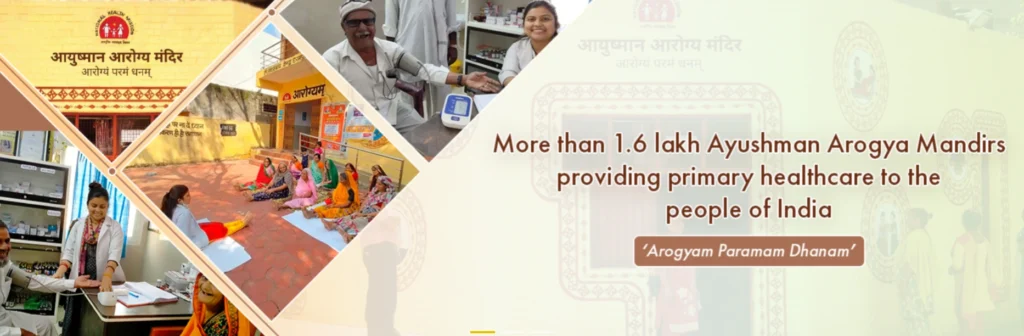
Ayushman Arogya Mandir is a revolutionary development in India’s healthcare system, with the goal of providing every citizen with complete, accessible, and reasonably priced treatment. Ayushman Arogya Mandirs are modern healthcare centers created to offer comprehensive basic medical care within close proximity to residents. They were established as part of the Government of India’s major healthcare projects. The idea is based on the goal of Universal Health Coverage, which guarantees that no person is denied access to necessary medical care because of financial, social, or geographic constraints. Ayushman Arogya Mandirs are revolutionizing the delivery of healthcare across rural as well as urban India by combining preventative, promotional, curative, therapeutic, rehabilitative, and palliative healthcare treatments under one roof.
Ayushman Arogya Mandir consists of two main parts: With an emphasis on wellness and the provision of a wider range of services closer to the community, 1,50,000 Ayushman Arogya Mandirs will be established under its first component to provide Comprehensive Primary Health Care that is universal and free for consumers. The second element is the Pradhan Mantri Jan Arogya Yojana (PM-JAY), which offers over 10 crore impoverished and vulnerable families health insurance coverage of Rs. 5 lakhs annually for secondary and tertiary care.
Beyond maternity and child health care, it is expected to provide a wider range of services, such as treatment for non-communicable diseases, palliative and rehabilitative care, oral, eye, and ENT care, mental wellness, and primary-level care for critical situations and trauma, including free necessary medications and standardized diagnostic services.
Table of Contents
Major Components of Ayushman Arogya Mandir
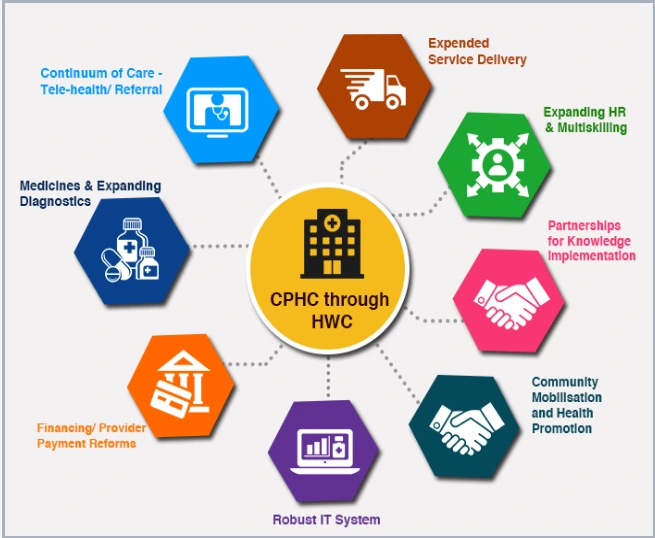
- Offers complete primary healthcare services, including palliative, curative, rehabilitative, preventative, and promotional treatment.
- Provides secure maternity services, dietary counseling, prenatal care, postnatal care, and prenatal monitoring to guarantee maternal healthcare.
- Provides healthcare services for children, including vaccinations, development tracking, dietary evaluation, and treatment of pediatric diseases.
- Provides adolescent medical care, such as nutritional counseling, mental health assistance, menstrual hygiene instruction, and reproductive health education.
- Encourages family planning and reproductive healthcare by providing access to contraceptive services and counseling.
- Carries out examination, diagnosis, and care of infectious disorders as leprosy, malaria, dengue, and tuberculosis.
- Makes it easier to identify and treat illnesses that are not transmissible like diabetes, high blood pressure, heart disease, and common cancer.
- Offers mental health services through recommendations, stress reduction, counseling, and early detection of mental health issues.
- Provides geriatric healthcare services, chronic illness management, and routine medical examinations to assist senior individuals.
- Guarantees the free availability of necessary medications to lower patients’ medical costs.
- Provides basic diagnostic services for prompt disease diagnosis and efficient treatment.
- Uses health education, awareness campaigns, and behavior change communication to encourage healthy living.
- Promotes community involvement in the development, execution, and monitoring of healthcare initiatives.
- Connects patients with medical professionals and specialists via telemedicine services.
- Improves healthcare delivery by integrating digital health technologies and maintaining electronic health records.
- Employs qualified Community Health Officers to improve community outreach and deliver high-quality basic healthcare.
- Creates a productive referral system to guarantee that patients receive specialized care when needed.
- arranges fitness promotional initiatives, yoga classes, and nutrition counseling, among other wellness programs.
- enhances community-level public health tracking and disease surveillance.
- facilitates the execution of national health initiatives pertaining to public health awareness, illness prevention, nutrition, immunization, and maternity health.
- emphasizes lowering out-of-pocket medical costs by increasing the accessibility and affordability of necessary medical treatments.
- Ayushman Arogya Mandir encourages underprivileged, rural, and urban groups to have fair access to healthcare services.
- Improves access to healthcare by bringing high-quality medical treatment closer to local populations.
- Promotes routine health checkups for disease prevention and early detection.
- Ensures that every individual has access to comprehensive healthcare, which helps achieve the objective of universal health coverage.
Services Available Under Ayushman Arogya Mandir:

A gradual approach to service growth has been proposed. Ayushman Arogya Mandir has implemented screening, prevention, control, and management of chronic communicable diseases like leprosy and tuberculosis as well as non-communicable diseases.
The following are the list of services available under the program:
- 1. Care in pregnancy and childbirth.
- 2. Neonatal and infant health care services
- 3. Childhood and adolescent health care services.
- 4. Family planning, Contraceptive services and Other Reproductive Health Care services
- 5. Management of Communicable diseases: National Health Programs
- 6. Management of Common Communicable Diseases and General Out-patient care for acute simple illnesses and minor ailments
- 7. Screening, Prevention, Control and Management of Non-Communicable diseases and chronic communicable disease like TB and Leprosy
- 8. Basic Oral health care
- 9. Care for Common Ophthalmic and ENT problems
- 10. Elderly and Palliative health care services
- 11. Emergency Medical Services
- 12. Screening and Basic management of Mental health ailment
Ayushman Arogya Mandir Serving as Boon to Assam Tea Garden Hospitals
Together, Ayushman Arogya Mandir and Assam Tea Garden Hospitals constitute a major step toward improving healthcare delivery in Assam, especially for vulnerable and underprivileged populations. Assam Tea Garden Hospitals especially address the healthcare needs of tea garden workers and their families, who are an essential component of the state’s economy, whilst Ayushman Arogya Mandirs concentrate on offering complete primary healthcare facilities at the local level.
By providing maternity and children health services, disease screening, immunizations, mental health care, necessary medications, diagnostic facilities, and health awareness programs, these organizations collaborate to increase access to high-quality healthcare. Ayushman Arogya Mandir help to lower health inequities and enhance general well-being by bringing healthcare services closer to communities, encouraging preventative care, and guaranteeing prompt treatment and referrals. By empowering communities, improving health outcomes, and creating a healthier and more resilient Assam, collectively, they support the goal of universal health coverage.
Assam’s primary healthcare system is being strengthened by Ayushman Arogya Mandir, especially in rural, isolated, wetlands, and tea garden regions where accessibility to high-quality healthcare has historically been difficult. These facilities ensure that vital health services are accessible closer to residents by acting as the initial point of interaction between communities and the healthcare system. Ayushman Arogya Mandirs are contributing to better health outcomes throughout the state through routine health checks, immunization campaigns, maternity and child healthcare services, and awareness campaigns.
Ayushman Arogya Mandirs’ merger with Assam’s current healthcare system has made it possible to effectively control infectious diseases like dengue, malaria, and tuberculosis, which are still major public health issues in some areas. Using regular examinations and early intervention, the centers are simultaneously addressing the rising burden of non-communicable diseases like diabetes, hypertension, and cardiovascular ailments. Healthcare accessibility has been enhanced by the use of telemedicine providers and digital health technology, which enable patients in rural areas to consult with medical professionals without having to travel great distances.
The existence of sizable tea garden populations is a distinctive feature of healthcare delivery in Assam. The state has been attempting to improve healthcare services in tea garden areas after realizing their unique healthcare demands. By offering healthcare services to tea garden workers and their families—who frequently deal with issues pertaining to maternal health, nutrition, sanitation, occupational dangers, and access to medical facilities—Assam Tea Garden Hospitals support the work of Ayushman Arogya Mandirs. Collectively, these establishments help to enhance the health and welfare of one of the most significant labor groups in Assam.
Ayushman Arogya Mandirs and Assam Tea Garden Hospitals are working together to increase illness prevention, lessen healthcare disparities, and foster healthy communities. Assam’s larger objective of improving public health outcomes and moving closer to universal health coverage is being supported by these programs, which guarantee access to comprehensive and reasonably priced healthcare services. Their influence goes beyond treatment; they promote community involvement, preventive healthcare practices, and awareness—all of which are critical to creating a more resilient and healthy Assam.
What is an Ayushman Arogya Mandir?
Ayushman Arogya Mandir is a government healthcare facility that provides comprehensive primary healthcare services, including disease prevention, health promotion, treatment, diagnostics, and wellness services closer to communities.
How are Ayushman Arogya Mandirs benefiting people in Assam?
Ayushman Arogya Mandirs are improving access to quality healthcare in rural, remote, tea garden, and riverine areas of Assam by offering essential medical services, free medicines, health screenings, and telemedicine facilities.
What is the connection between Ayushman Arogya Mandirs and Assam Tea Garden Hospitals?
Both initiatives work towards strengthening healthcare delivery in Assam. While Ayushman Arogya Mandirs provide primary healthcare at the community level, Assam Tea Garden Hospitals offer specialized healthcare support to tea garden workers and their families.
Are services at Ayushman Arogya Mandirs free?
Yes, most services such as health consultations, maternal and child healthcare, immunization, disease screening, essential medicines, and basic diagnostic tests are provided free of cost.
Why are Ayushman Arogya Mandirs important for Assam’s healthcare system?
They help reduce healthcare disparities, improve early disease detection, strengthen preventive healthcare, and ensure that quality healthcare services reach underserved populations across the state.
You May also read:
Follow us for more content: