
International Day against Drug Abuse and Illicit Trafickking is observed every year on 26th June. This day was decided to be observed on the basis of a resolution passed by the United Nations General Assembly as an expression of its determination to strengthen action and cooperation to achieve the goal of an international society free of drug abuse. Supported each year by individuals, communities, and various organizations all over the world, this global observance aims to raise awareness of the major problem that illicit drugs represent to society.
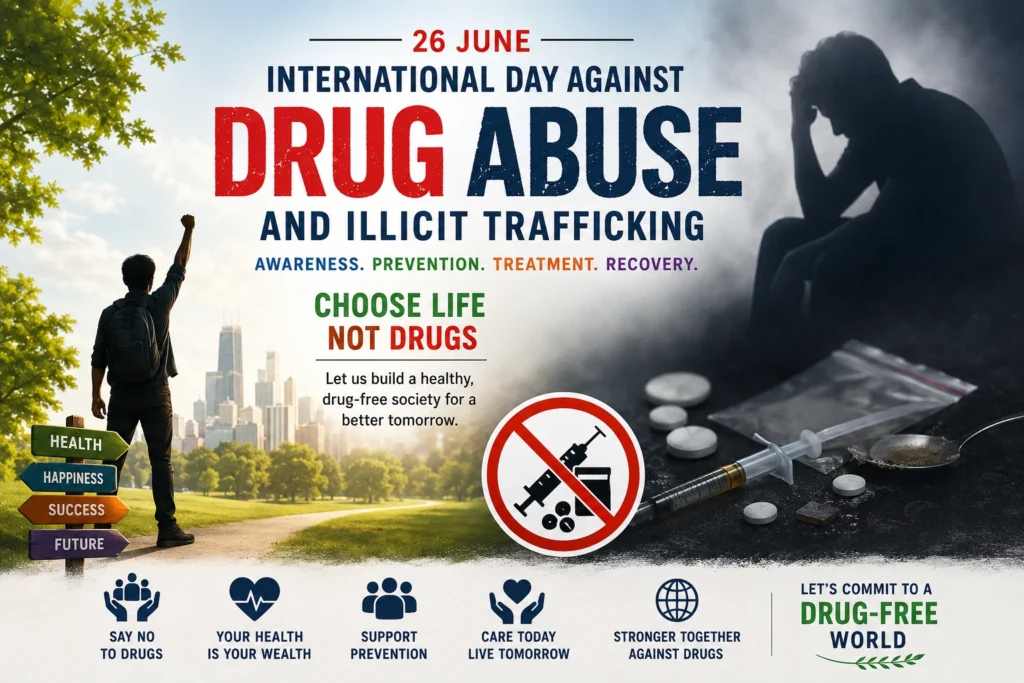
Drug abuse or addiction is a global issue since last two decades. One of the most important social and public health issues of the twenty-first century is drug addiction. Millions of individuals worldwide suffer from the abuse of narcotics and psychotropic chemicals, which can result in major health issues, broken homes, criminality, unemployment, poverty, and a decline of human potential. Illegal drug trafficking, on the other hand, poses a serious threat to both domestic and global security since it feeds organized crime, corruption, violence, and terrorism.
The International Day Against Drug Abuse and Illicit Trafficking highlights the fact that substance abuse is a social and health issue in addition to a criminal one. In addition to bolstering law enforcement against illicit drug networks, it advocates for compassionate strategies that place a high priority on prevention, treatment, rehabilitation, and social reintegration.
Table of Contents
What is International Day against Drug Abuse and Illicit Trafficking?
The International Day against Drug Abuse and Human Trafficking is an annual global observance on 26th June declared by UN General Assembly. It is a day to promote awareness amongst youth about substance abuse and its negative impact on mind, health and overall well-being of the society. The following are the main objectives of this day:
- Raise awareness about the harmful effects of illicit drugs.
- Encourage prevention and education programmes.
- Support treatment and rehabilitation for people struggling with addiction.
- Promote international cooperation against illegal drug trafficking.
- Strengthen public health responses to substance use disorders.
- Reduce the social stigma associated with seeking treatment.
- Governments, schools, universities, healthcare institutions, youth organizations, law enforcement agencies, and community groups organize seminars, awareness campaigns, rallies, workshops, exhibitions, sports events, and social media campaigns to educate people about the dangers of drugs and the importance of healthy lifestyles.
History and Origin of the International Day against Drug Abuse and Illicit Trafficking
The United Nations General Assembly founded the International Day Against Drug Abuse and Illicit Trafficking on December 7, 1987, by adopting Resolution 42/112. The International Conference on Drug Abuse and Illicit Trafficking, which emphasized the pressing requirement for concerted international action against the escalating problem of illegal narcotics, preceded the decision. The Comprehensive Multidisciplinary Outline of Future Activities in Drug Abuse Control, which offers a path for global collaboration in lowering drug demand and upending illicit supply chains, was endorsed by the conference. The day has been celebrated on June 26 every year since 1988.
The United Nations Office on Drugs and Crime (UNODC), which collaborates with governments and partner groups worldwide to address issues pertaining to narcotics, organized crime, corruption, terrorism, and criminal justice, is currently in charge of organizing the event.
Theme of International Day against Drug Abuse and Human Trafficking 2026
The theme selected for this year is “World drug problem: persisting issues, new challenges, innovative responses. “
Nasha Mukt Bharat Abhiyan
Nasha Mukt Bharat Abhiyaan (NMBA) was launched on 15th August 2020 by the Ministry of Social Justice & Empowerment in 272 Districts identified as most vulnerable in terms of substance use. The Abhiyaan on 15th August 2023 has been expanded to all Districts of the country. Being a campaign mode programme, the Abhiyaan has targeted and involved stakeholders that might be directly or indirectly affected by substance abuse and those who are vulnerable to it. The major stakeholders and beneficiaries of the NMBA are Youth, Women, Children, Educational Institutions, Civil Society, and the Community at large.
Nasha Mukt Bharat Campaign is a three-pronged attack combining the supply curb by Narcotics Control Bureau, Outreach and Awareness and Demand Reduction effort by Social Justice and Empowerment and treatment through Health Department.
The identified districts are responsible for leading the implementation of the Nasha Mukt Bharat Abhiyaan through District Level Nasha Mukt Committees formed specifically for this purpose. These committees are headed by the District Collector or District Magistrate, who, along with other members, prepare and oversee the District Level Action Plan to ensure effective execution of the Abhiyaan within their region.
At the state level, State Abhiyaan Committees monitor the activities of all selected districts. These committees are chaired by the Principal Secretary or Chief Secretary of the department responsible for drug prevention programmes in the state. Their role is crucial, as they track the progress of district-level efforts and provide necessary guidance, coordination, and support.
At the central level, the Ministry of Social Justice & Empowerment oversees the overall implementation of the Abhiyaan. Monitoring is carried out through multiple established mechanisms as well as through the State Coordinators of the Project Monitoring Unit, ensuring that the campaign progresses smoothly across all targeted districts and states.
At the district-level, the District Level Nasha Mukt Abhiyaan Committees, chaired by the District Commissioner or District Magistrate and consisting of representatives from key stakeholder departments such as Health, Education, Women & Child Development, NCB, Police, and various organizations working in this field, have been given the responsibility of implementing and monitoring the Abhiyaan in their respective districts. These committees prepare the district action plan and guide all major activities under the Abhiyaan, ensuring effective coordination and execution.
Pledge against Drug Abuse:
Government of India is seeking its citizens to take a pledge on this occasion for building a better tomorrow. The pledge is as follows:
In Hindi:
“प्रिय साथियों,
युवा किसी भी राष्ट्र की ऊर्जा होते हैं तथा युवाओं की शक्ति का समाज एवं देश के विकास में महत्वपूर्ण योगदान है। अतः यह अति आवश्यक है कि नशामुक्त भारत अभियान में सर्वाधिक संख्या में युवा जुड़े। देश की इस चुनौती को स्वीकार करते हुए हम आज नशामुक्त भारत अभियान के अंतर्गत एक जुट होकर प्रतिज्ञा करते हैं कि न केवल समुदाय, परिवार, मित्र, बल्कि स्वयं को भी नशामुक्त कराएँगे क्योंकि बदलाव की शुरुआत अपने आप से होनी चाहिए। इसलिए आइए हम सब मिलकर अपने ज़िले/ राज्य…..(नाम) को नशामुक्त कराने का दृढ निश्चय करें। मैं प्रतिज्ञा करता हूँ कि अपने देश को नशामुक्त करने के लिए अपनी क्षमता के अनुसार हर सम्भव प्रयास करूँगा।
जय हिन्द!”
In English: ” Dear friends,
Youth is the energy of any nation and the power of youth has an important contribution in the development of society and country. Therefore, it is very important that maximum number of youth join the drug free India campaign. Accepting this challenge of the country, today we unite under the Nasha Mukt Bharat Abhiyan and take a pledge that not only the community, family, friends, but also ourselves will be drug free because change should start with ourselves. So let us all together take a firm decision to make our district/state…..(name) drug-free. I pledge that I will do everything possible to the best of my ability to make my country drug-free.
Jai Hind!
Why is the International Day Against Drug Abuse and Illicit Trafficking observed?
The day is observed to educate people about the harmful effects of drug abuse, encourage prevention, support rehabilitation, reduce stigma surrounding addiction, and promote international cooperation in combating illegal drug trafficking.
When was the International Day Against Drug Abuse and Illicit Trafficking established?
The United Nations General Assembly established the observance in 1987 through Resolution 42/112, and it has been observed annually since 1988.
Which organization leads the global observance of World Drug Day?
The United Nations Office on Drugs and Crime (UNODC) coordinates the global observance by organizing awareness campaigns and working with governments and partner organizations worldwide.
What is Nasha Mukt Bharat Abhiyan?
Nasha Mukt Bharat Abhiyan (NMBA) is a nationwide campaign launched by the Government of India to prevent substance abuse, raise awareness about the harmful effects of drugs, and promote a drug-free society through education, community participation, and rehabilitation.
When was Nasha Mukt Bharat Abhiyan launched?
The campaign was launched on 15 August 2020 by the Ministry of Social Justice and Empowerment to address the growing problem of substance abuse, especially among youth.
Which ministry implements the Nasha Mukt Bharat Abhiyan?
The campaign is implemented by the Ministry of Social Justice and Empowerment (MoSJE) in collaboration with the Narcotics Control Bureau (NCB), state governments, educational institutions, NGOs, and other stakeholders.
You may also read: https://wisdomjuncture.com/india/
Follow us for more content